



17 Jul July 2026 Newsletter
July 2026 Newsletter
Welcome to the July 2026 edition of the Daniels Foundation Newsletter. In this issue, we explore the following topics. Click on the links to read the articles!
Trends in Foundation Giving! Two major events have happened in Foundation giving since 2020. The first was the COVID pandemic, and the second… Click here to read more…
Grantee Spotlight: The Mustard Seed! It’s hard to miss the larger than average lot on Piedmont street… Click here to read more…
Thetford Academy! At what point is someone labeled a historian? Or are they a genealogist?… Click here to read more…
Grantee Spotlight: Dollar $cholar! For many years the Daniels Foundation has funded the Women’s Initiative and, by extension, The Dollar $cholar … Click here to read more…
The Beach House! For as long as I can remember, just about every summer, I’ve gone to The Beach… Click here to read more…
Trends in Foundation Giving
by Fred Daniels
Two major events have happened in Foundation giving since 2020. The first was the COVID pandemic, and the second is the cuts to funding from the Federal government associated with the current administration. The response from the not-for-profit community has been completely different to each of these, and grant applications to the Daniels Foundation support this observation.
I took a look at the data we maintain in our Foundant Grant Making software. We started using Foundant in late 2015, and so the data compiled below starts with the 2016 calendar year. The primary criterion was the year of the first grant application to the Foundation, suggesting that is when our relationship with the agency began.
| Year | Number of First Grants |
|---|---|
| 2016 | 55* |
| 2017 | 14 |
| 2018 | 6 |
| 2019 | 8 |
| 2020 | 7 |
| 2021 | 5 |
| 2022 | 9 |
| 2023 | 9 |
| 2024 | 3 |
| 2025 | 15 |
*This high number reflects the agencies which we funded prior to and including the year 2016 (going as far back at 1949!)
COVID officially began in March of 2020, and the World Health Organization officially declared the pandemic over in May of 2023. You can see in the early COVID years that the pace of new applicants was similar to the years just prior. In the last two official years of the COVID pandemic you can see an increase in new applications, suggesting that agencies had begun to recognize that the pandemic was stabilizing and that they could, in fact, return to a somewhat “normal” business model.
In 2024, the first year of the current Federal administration, you can see a dramatic drop off in new grant applications. What the Board of the Foundation was hearing is that agencies were very cautious, very concerned, and were trying to ascertain what the proposed funding cuts would mean to them. You might think they would have all been scrambling to submit applications, but many of them were busy staffing back up and getting their programs re-launched after the pandemic.
What we have seen this year and last is a substantial increase in new applicants, the greatest number since 2017. Agency leaders tell us that cuts in Federal allocations have now trickled down past the state and are, in fact, substantially lower than in the past two years. Not-for-profit organizations are turning to the private foundation sector to try and make up the difference. This, plus new applications from the farthest reaches of Worcester County, may account for the sudden increase.
And this fact is being seen nationally. According to Foundation Sources 2025 Report on Private Philanthropy, more applicants are applying for general operating grants than in prior years, and we are definitely seeing this trend. “Smaller foundations awarded a higher proportion of GOS grants (49.4%) than midsize (42.6%) or larger foundations (26.9%).”
By way of process, as the number of new applicants increases it becomes even more important to emphasize the desired impact of the gifts we give. This has always been a priority, and we are examining ways that we can better determine whether the funds we provide are, in fact, providing the proscribed impact. We need to do better at this, so that the limited funds we can provide are able to help even more people and communities.
Grantee Spotlight: The Mustard Seed
by Emily Daignault-Salvaggio
It’s hard to miss the larger than average lot on Piedmont street. Even more so during the nightly hours that the volunteers at the Mustard Seed are serving dinner to all who come and need the sustenance. Beyond the food they have clothing, hygiene items and blankets. They run clinics for vaccines and medical care. And throughout they serve on average 500 people a week. Charitable donations, grants, volunteers and dedicate workers are what’s kept the Mustard Seed running since 1972.
When you start from scratch and try to find the history and the impetus for this vital organization, two things come up first. The origin story of the Catholic Community worker and the impact of Dorothy Day. And then you must dig a bit into the Book of Luke to find the source of the name.
“Luke 13:18-21 – New King James Version
The Parable of the Mustard Seed
Then He said, “What is the kingdom of God like? And to what shall I compare it? It is like a mustard seed, which a man took and put in his garden; and it grew and became a large tree, and the birds of the air nested in its branches.”
The tiniest of seeds planted and cared for and nurtured onwards can become so many things in the world we live in. And while a mere seed may only need water, temperate soil and ideal conditions, a community outreach program based off the ideals led by Dorothy Day would need much more to meet the standard of an impactful place for all the people who needed the aid to carry on their lives. The Catholic Worker movement founded by Day and Peter Maurin in 1933 had its goal as “living in accordance with the justice and charity of Jesus Christ”. One of its guiding principles is hospitality towards those on the margin of society. From this influence sprouted the beginnings of what we see now as the Mustard Seed.
Founded in 1972 by Frank Kartheiser & Michael Boover, the Mustard Seed bloomed with influence from the Anti-Vietnam war movement and Bohemian Activism. Giving back to others and helping to provide not only for the victims of the war but also the people affected by the economic aftereffects of the long drawn out conflict helped to solidify the need for such an organization, and the reach and branches stretched as the community helped the agency to strengthen its roots.
Now, 54 years later the community celebrates as the small house with a large yard and picnic tables overlooking a manicured grass area revels in the meals shared over a 54 year presence. They know they need to solidify the donations and increase the amount of capacity they can undertake. Changes in the world of donations have threatened to prune away vital established branches of even the most vibrant establishments. But in 2026 the internet can bring more friends with change for a donation than you might think. Venmo, Amazon Wish Lists, PayPal and the like have helped enhance the fodder that surrounds those doing the best work for those in need. Creativity and constant communication in the form of social media posts help to draw more volunteers and donors in.
The Daniels Foundation has supported many community organizations that help to feed the people of Worcester. The Mustard Seed has been a grantee for 5 years and we cannot wait to see how much more our grants can do to strengthen their operations in their upcoming 55th year of service.
Thetford Academy
by Bill Pettit III
At what point is someone labeled a historian? Or are they a genealogist? Or more likely some of both. Do they have to have a degree? Or be published in the New England Journal of Loose Ends Tied Up. Whatever, no real answer there except sometimes I realize I have both and I am a pack rat as well. By that I mean I have accumulated a vast quantity of ephemera, letters, pictures, clippings, books, diaries on and on. So much so that I worry I am some sort of hoarder. Ah, I relax because I am not saving plastic grocery bags in my bathroom…
So… let me tell you a personal story that at first I was sure it wasn’t going to lead anywhere. But by the end my genealogy head was melded with the historical head to be completely blown.
Step One, Fred Daniels, President of the Daniels Foundation sends to me an email in 2025 asking me to : “once and for all prove or disprove if we are related to Robert H. Goddard. “
A bit of background: Fred’s grandfather Harold (who was second son of Fred Harris Daniels and first president of the Fred Harris Daniels Foundation, Inc.) married Eleanor Grace Goddard in 1915, both neighbors on Salisbury Street in Worcester.
Robert H Goddard is considered the man who began the space age by his work with liquid fueled rockets. That of course we all know allowed for the future development of space flight. He taught at Princeton and Clark University in Worcester as well as studying at WPI.
And 2025 was the 140th birthday of Robert, so with the rebirth of the U S space program he was in the news again.
I emailed back to cousin Fred saying I had looked into the connection years ago and it was a dead end, but I’ll give it a look see again.
This time Wikipedia proved very interesting. Heretofore my research into Goddard had yielded his rocketry and science credentials, all created in Worcester, but I could find nothing about his heritage.
This time there was much of his early life which pointed to a long generational presence in Worcester and eastward back to William Goddard who settled in Watertown Massachusetts in the mid-1600s. Well, that was fun because our Robert Daniels settled in Watertown in 1630-ish and from Robert all us Daniels flowed.
So, Robert Daniels might have known William Goddard but what is known in the record is that their progeny ended up in Worcester together in the 1800s. I could only conjecture that Robert H Goddard, born in 1882 in Worcester, and Fred Harold Daniels, born in Worcester in 1887, must have known each other. But were they related? My feelings formed by years of amateurishly studying family histories: if the persons were at the Thanksgiving table together, they would acknowledge the relationship. If not, they could very well be first cousins but no one knew it.
End of Step one.
Oh, but wait. The question is not whether Uncle Harold knew Robert Goddard, but rather was Auntie Nell related to Robert Goddard? My Thanksgiving table theory still leans to “no”; we wouldn’t be asking the question because it would be part of the known family history.
Step two, I had to dig into this question from Auntie Nell’s side.
Before we go on, I have to get personally involved in this treasure hunt. Back in the last century, late 1960s/early 1970s, the Foundation meetings were very different from today.
I had the good fortune to go to a couple of Christmas Foundation meetings courtesy of my parents. I have solid recollections of Bruce Daniels running the meetings and board members Daniels, Pettit, Blake and Nicolson etc. approving whatever Bruce said.
Bruce waving some paper back and forth. “I have the usual letter from the Home for Aged men asking for the usual gift, all in favor say aye.”
“Ahem, cough cough” the board would mutter and done…
However, one letter would come up, inevitably at the end of the meeting.
“Oh wait, I have a note from Thetford Academy. We should sent them five hundred, it was a favorite of Mother’s,” Bruce would almost forget.
“Done” would say the clerk from the Mechanics Bank.
And then afterwards we all go to 190 Salisbury Street. Chrissy Eaton has some stellar photos of those gatherings…
Somewhere in the car ride or at the shrimp table someone always said “What is Thetford Academy,” and no one, not one person knew of it, but the Foundation funded it for years and years.
By 2025 when I left the board I knew I would never be able to find out why Thetford Academy. Pretty obvious Auntie Nell was enthralled with whatever it is or was that Thetford Academy does or did but oh well…
So, back to seeing if Auntie Nell and the Rocketman were related.
Right away came some surprises. One of my reference books is: Biographical Sketches of the Pioneer Settlers of New England and Their Descendants in Worcester Massachusetts. By Charles Henry Dooley – 1964.
One of the Pioneer Settlers sketched is Willam Goddard. Eleanor is the eighth generation, with her father being Harry W. Goddard.
Harry W. Goddard He was the builder of 190 Salisbury St. It is generally known that he was a successful businessman and maybe we knew he was in the wire business. But beyond that I did not know much. So, reading this little bit excited me. Harry was born in Holyoke and came to Worcester to study. He was “Mechanically inclined and at the age of seventeen started work at the Washburn and Moen Company.” That would have been 1880 and Fred Harris Daniels was already working there. Harry springboarded away a year later to join the Spencer Wire Company of which he would end up being president, and by buying out the other owners the sole owner. Harry went on to excel in other business areas and died in 1927.
Harry’s father was Dorrance S. Goddard. And Dorrance also had a son named Dwight Goddard. (1861 -1939) Dwight was married 3 times and was born in Worcester and died in Thetford Vermont.
Born in Worcester in 1861 a few years after Fred Harris Daniels. Educated at WPI and became a mechanical engineer at Washburn and Moen . But he “cared little for business, his thoughts turned to religion.” He studied at the Hartford Theological Seminary and became a missionary at Foochow, China. He came back to this country in 1900 and went to work at Wyman Gordon Company, also in Worcester. But that was not working for him so he went back to China. It was there that he found his life work by converting to Buddhism . He soon moved back to Vermont and settled in Thetford and about 1934 founded the American Brotherhood of Followers of Buddha with hermitages in Thetford and Santa Barbara.
There still is a Thetford Academy in Thetford Vt.; a private independent school founded in 1819. Sadly, Dwight Goddard’s endeavors in Thetford would not pan out. Was he connected to the Thetford Academy that exists today? I could not find a connection and nowhere was I able to connect Auntie Nell to Robert Goddard. The research found that Auntie Nell’s uncle was Dwight Goddard, but what I thought at first was that Dwight Goddard founded Thetford Academy, but like the relationship to Robert Goddard the relationship between Auntie Nell and Thetford Academy will be vague and perhaps always one step removed. History and the plotting of history is always one step away. When we historians get answers to questions, it turns out that the answers always create more questions.
The one thread that ties us all together woven through all of this time is Washburn Moen and Worcester Tech. Education and vocation. That is worth pondering.
Grantee Spotlight: Dollar $cholar
by Rob Pettit
For many years the Daniels Foundation has funded the Women’s Initiative and, by extension, The Dollar $cholar. The Dollar $cholar Program aims to help empower young women through financial education. The program teaches girls aged 10-14 about financial literacy and provides them with positive role models to reduce incidents of violence towards women.
Hosting 1 day seminars, often at colleges featuring college volunteers, over 100 girls go through a variety of topics. Budgeting, College prep, high school jobs, taxes, credit cards, ways to earn money and save money as well as the dangers of lending apps and online phishing are all discussed.
Currently the program is offered in over 30 schools in 8 counties in Central Massachusetts. To date it has served over 6000 girls with over 2500 adult mentors.
Dollar $cholar is now focusing efforts on expanding its reach outside of Central Massachusetts, recruiting a wider diversity of mentors, as well as offering printed materials in different languages.
The Beach House
by Carlos La Hoz Daniels
For as long as I can remember, just about every summer, I’ve gone to The Beach. The Beach is a small and as far as I know nameless private beach on Cape Cod, tucked into a little cove facing Buzzard’s Bay in the village of Woods Hole. At the neck of a peninsula that reaches out towards Buzzard’s Bay before curling back on itself toward Nonamesset island, The Beach lies on one side of a narrow isthmus that connects the peninsula, known as Penzance Point, to the mainland, and at more or less the precise point where it does so there is a house, the Beach House.
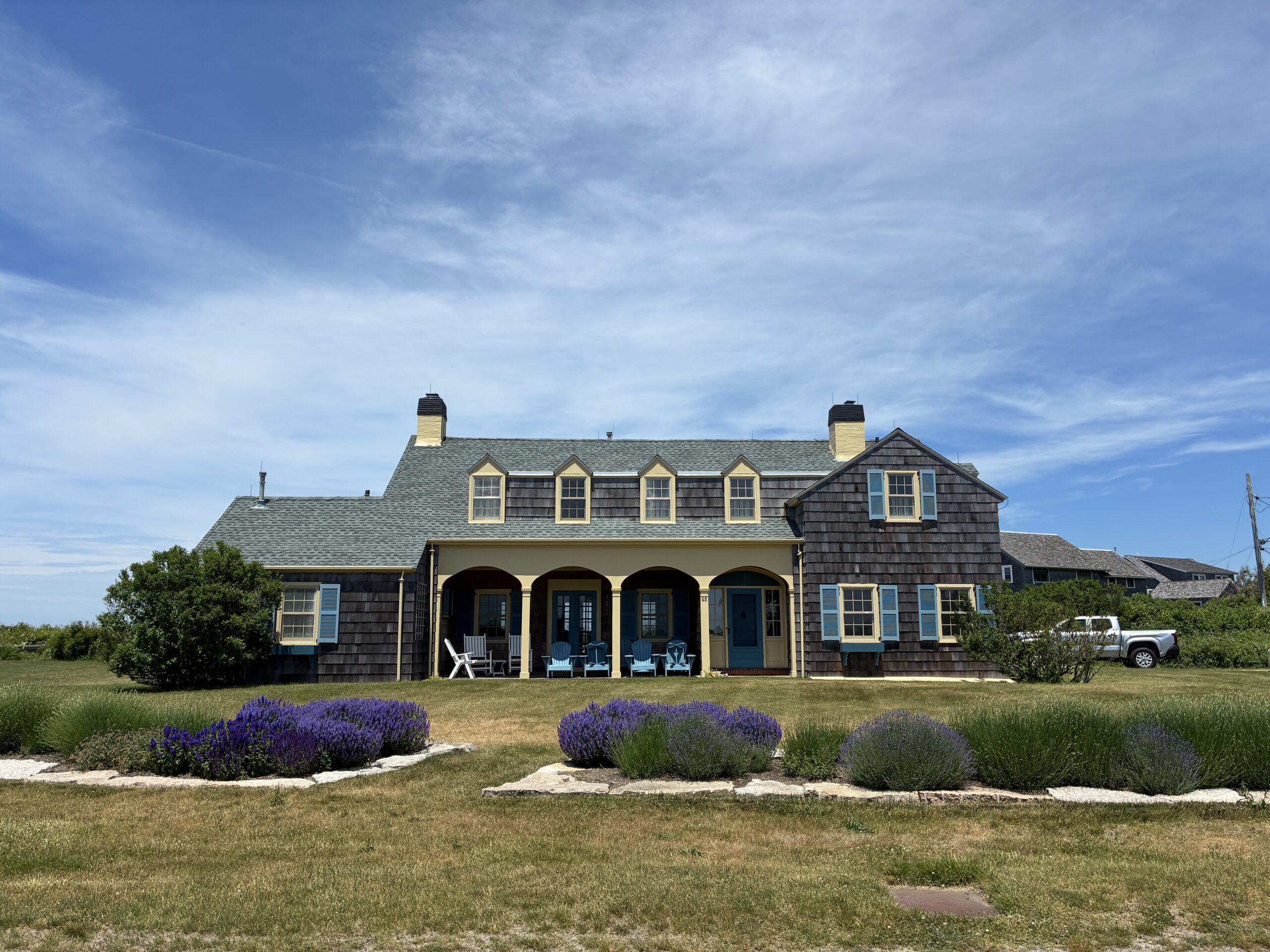
The Beach House, as seen from Bar Neck Road in June 2026
Bruce Goddard Daniels was 13 when his father Fred Harold Daniels bought the Beach House. Before then, he’d spent his summers on Cape Ann, near Gloucester, or up in Maine at a house on Petit Manan Point. The year was 1938, and the beginning was inauspicious to say the least; that fall, a monstrous storm came up out of the Atlantic and struck Long Island as a category 3 hurricane before moving north and inland across Connecticut. As this was before there was an official naming system for North Atlantic hurricanes, it is best known to history as the Long Island Express. In any case, it did a great deal of damage as the worst hurricane to hit the Northeast since colonial times, and it sent a huge storm surge up the Connecticut river and along the coast into Narragansett Bay and Buzzard’s Bay. The walls on one end of the Beach House were destroyed by the surge; Falmouth was flooded under eight feet of water; and the caretaker of the house, who’d come to check on it at precisely the wrong time, was swept out to sea. His son, who was with him, survived by clinging to a telephone poll.
Fred rebuilt that portion of the house that was destroyed and eventually built another bedroom onto that side of the house as an addition. That end of the house was once again destroyed in 1954 by Hurricane Carol, which followed very nearly the same track as the Long Island Express had. That was the last hurricane to drive storm surge to those levels. Fred, being an engineer, conceived and built a seawall out of concave concrete castings across the back of his portion of the Beach in 1962, where it remains to this day untested by any storm with as great a storm surge as the hurricanes of 1938 and 1954.
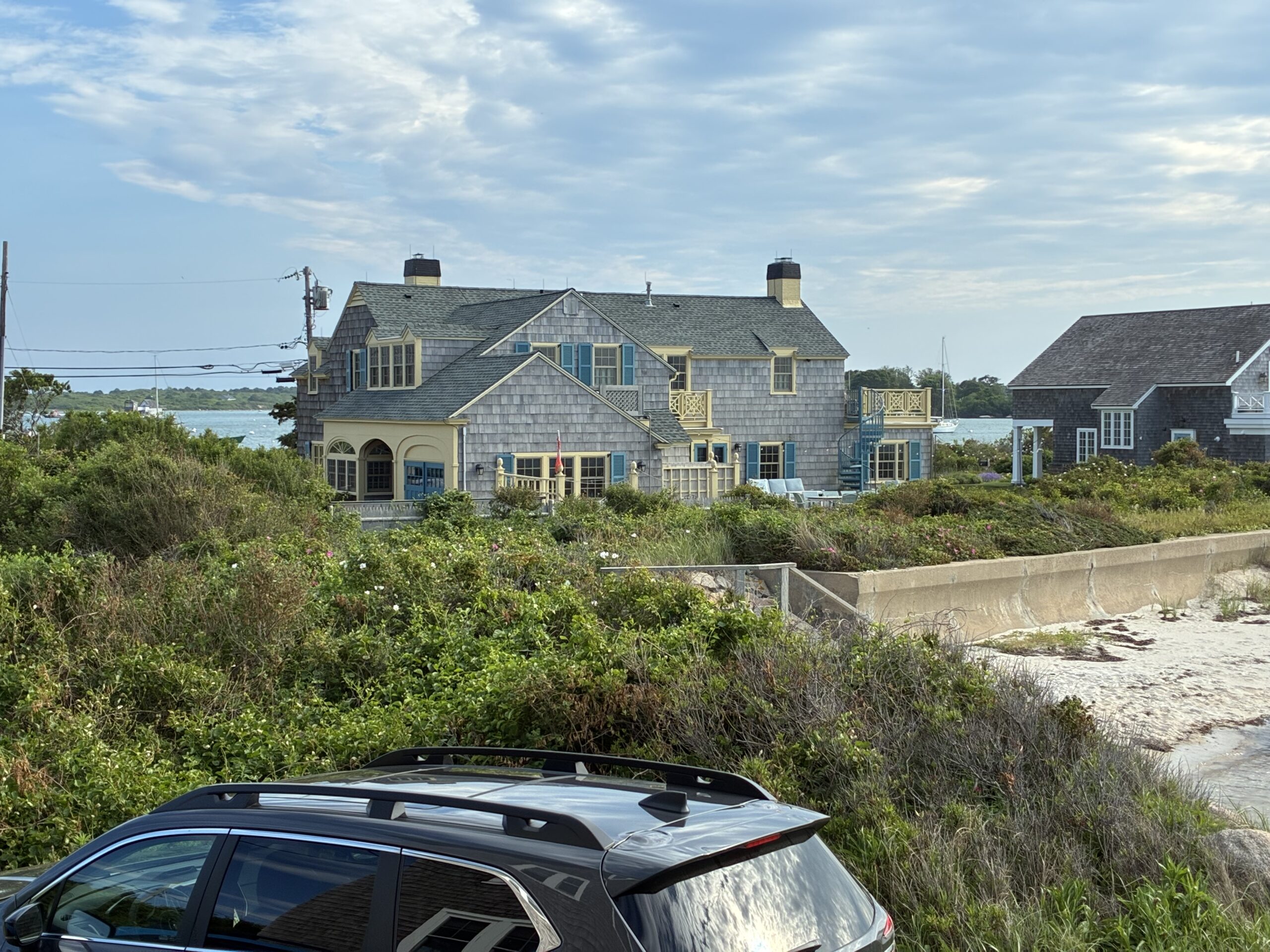
The beach side of the Beach House; Fred’s seawall can be seen on the right
And so it was that the children of Bruce Daniels, who eventually inherited the house from his father, grew up spending summers at the Beach House, to which Bruce and Janet would retire each year in June. And they, in turn, would bring their own children to the house as they began to have families of their own. In those days, Grandma and Grandaddy, as we grandchildren knew them, were still the owners and primary residents of the house, and we came to visit them there where they held court. The house was of older stock, having been built in 1920. Two stories and basically L-shaped, it was shingle-sided and had no basement; indeed, it was possible to see and even crawl under the house from certain points along the exterior. The kitchen was redone in the 1970’s, with metal cabinetry, linoleum tiled floors, glass sliding doors to the yard and a small spiral staircase going up to the second level, but the rest of the house was old, dark and stately. Hardwood floors, dark and smooth with age, walls of stout southern pine, doors with old Suffolk thumb latches, and ever-present hints of sand and salt. And always, you could hear the sounds of the sea.
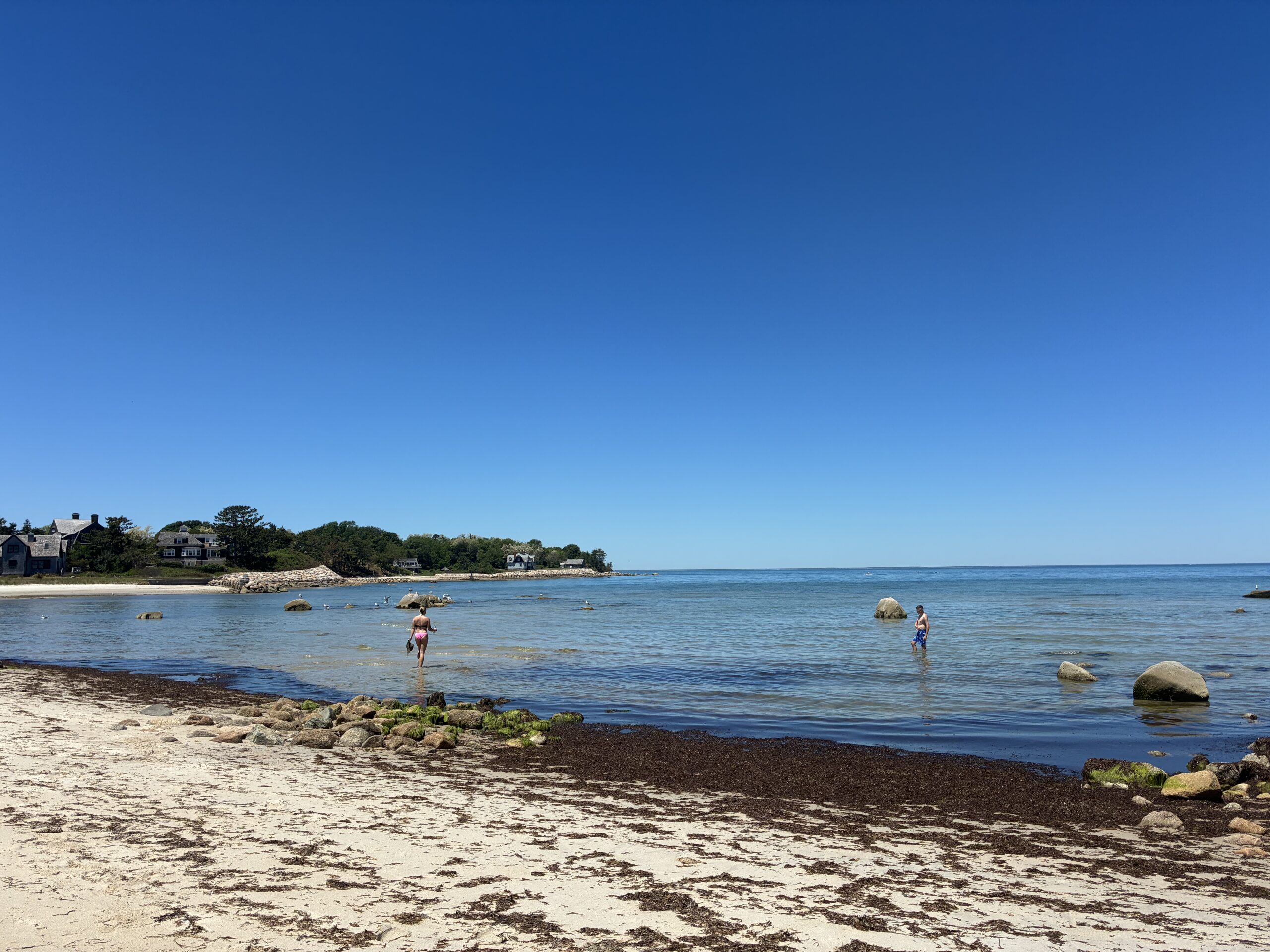
The Beach in June 2026
My grandparents would spend their mornings at the kitchen table playing cribbage or backgammon before Grandaddy inevitably moved to the living room to plant himself in his comfortable, grey-cushioned Ikea chair and read the Boston Globe, and from whence he rarely moved for the rest of the day. Grandma would usually putter about the place or join us on the Beach for a while before she too retired to the living room to take up her own throne, a squat, squared off lime green affair that was probably quite fashionable in the 1970s when they acquired it, but by the 1990s was distinctly anachronistic. There were almost always cousins around the place. As it was just my mother and I, we generally fit into the place alongside my grandparents and one of my aunts or uncles and their families; the Beach House was a big place with 7 bedrooms, most of which could sleep at least 2.
We grandchildren would spend our days at the Beach collecting sea glass, climbing the breakwater, making sandcastles on the sand bars before the tide inevitably came to wash them away, catching the hermit crabs that were abundant in the tidal pools formed by the sandbars and swimming in the warm, shallow water. If it was high tide, we might take the old Sunfish out, mastless, with oars stolen from the even older rowboat, throw out the anchor over a sandbar, and dive off it. Or we would go out to the rocks by the breakwater and fish for crabs with bits of mussels we smashed open, or scraps from the kitchen, tied on string. Lunch was eaten in the kitchen or sometimes on the picnic table on the patio. We were warned, with dire imprecations, not to track sand in the house, so we learned to rinse our feet at the outdoor spigot stationed over a rusty grate next to the sliding doors that went into the kitchen.
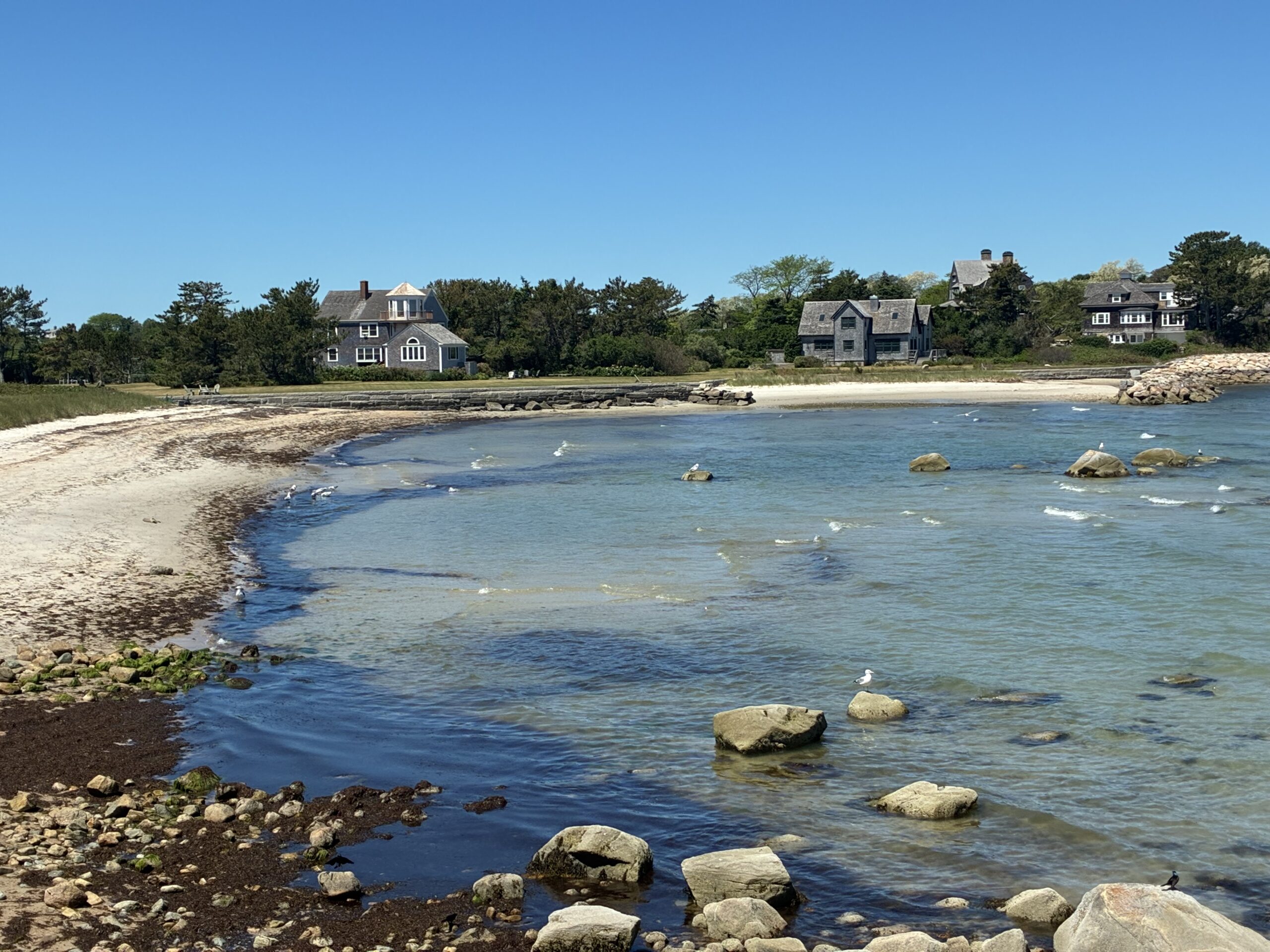
The Beach, as seen from roughly it’s northern end; the Beach House is on the left, out of frame
As the years passed, my generation also had children, some of whom became the fourth generation of Daniels children to spend time at the Beach House. As Bruce and Janet passed from the scene the house was bequeathed to my parents’ generation, who eventually made the difficult decision to sell it. It wasn’t an all-season house, the upkeep costs were considerable, one more good hurricane could potentially destroy it at any time, and sharing a vacation home among five families wasn’t always easy (either logistically or emotionally). We sold the Beach House in 2017 or so, and with it a Harold line legacy of almost 80 years.
Sorry, the comment form is closed at this time.